

1 October 2026
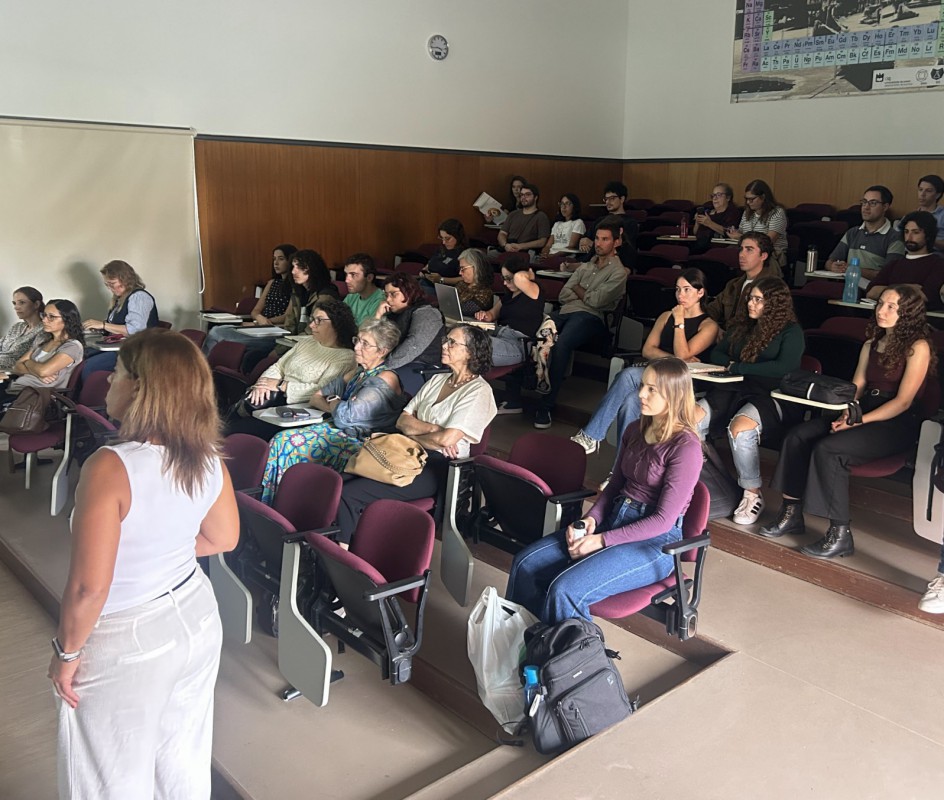
The Department of Chemistry of the University of Aveiro (UA) hosted the talk "From University to Industry: the path of a chemist in Research, Innovation and New Product Development" on 30 September. The session took place in the Department's amphitheatre, within the programme marking the Department's 50th anniversary and the 25th anniversary of CICECO – Aveiro Institute of Materials.
The speaker was Célia Lopes, head of Innovation and Research at PinoPine, a company that is part of Grupo RB. She returned to the university where she completed part of her training, with a Master's degree in Analytical Chemistry: Instrumental Methods and Analytical Quality Control, followed by a degree in Management, both from UA. With more than two decades in the chemical industry, she has moved from leading an analytical laboratory to coordinating innovation projects.
From the pine tree to the product
The talk was built around PinoPine's raw material (pine resin) and production expertise. Célia Lopes began with the trees themselves, presenting the main resin-producing species. In Portugal and Spain these are the stone pine (Pinus pinea) and the maritime pine (Pinus pinaster). Beyond Europe, the species mentioned included Pinus elliottii and Pinus caribaea in Brazil, Pinus massoniana and Pinus kesiya in China, and Pinus merkusii in Indonesia.
She then followed the resin through its transformation. After tapping, the raw gum resin goes through a first transformation: a cleaning stage that removes impurities such as water, insects and debris, followed by distillation. Distillation separates the two main fractions, rosin, a solid, and turpentine, a liquid. A second transformation turns both into a range of derivatives.
One of the central themes was PinoPine's production cycle explained from the reception of raw materials to dispatch.
It showed four main activities:
- distillation of filtered gum resin to separate rosin and turpentine;
- melting of solid rosin, used as a direct raw material;
- production of rosin derivatives in reactors, finished in four lines: flakes, pastilles, liquids and granules;
- production of aqueous dispersions.
The session had a clearly hands-on side. Célia Lopes brought samples of PinoPine products and passed them around, so that students and researchers could see and handle the materials discussed. The samples included the raw material, turpentine and aqueous dispersions.
A bridge between industry and academia
By linking a species of pine to a finished industrial product, the talk showed how analytical chemistry, research, product development and sustainability connect in practice. It also gave students and young researchers a direct view of careers in industrial R&D, from an alumna who knows both sides.
The session also reflects the close relationship between the University of Aveiro, CICECO and the regional industry, and illustrates how knowledge created in the lab can be used to add value to renewable, forest-based raw materials.
Related Articles

Researchers

Sofia M. Bruno
Assistant ResearcherWe use cookies for marketing activities and to offer you a better experience. By clicking “Accept Cookies” you agree with our cookie policy. Read about how we use cookies by clicking "Privacy and Cookie Policy".