

28 October 2026
A new bilateral framework identifies five priority areas for research and innovation, creating a basis for joint funding, researcher mobility and collaboration between scientific institutions and industry. For CICECO, the agreement builds on existing links with Chinese partners and opens potential avenues for cooperation in energy, health, sustainable materials and advanced technologies.
Portugal and China have agreed on a new framework to strengthen scientific and technological cooperation, establishing five priority areas and preparing the ground for a joint action programme covering 2027–2030. The agreement was formalised on 19 October 2026 in Beijing, where Portugal’s Minister for Education, Science and Innovation, Fernando Alexandre, and China’s Minister of Science and Technology, Yin Hejun, signed a Joint Declaration at the 10th Portugal–China Joint Commission on Science and Technology. The meeting marked the resumption of the Commission’s work, which had been interrupted since 2019.
According to the Portuguese Government, the two countries will develop a joint action programme to guide cooperation in science and innovation until 2030. Technical meetings scheduled for 2027 will help define the instruments through which the framework can be implemented.
Five priority areas for research and innovation
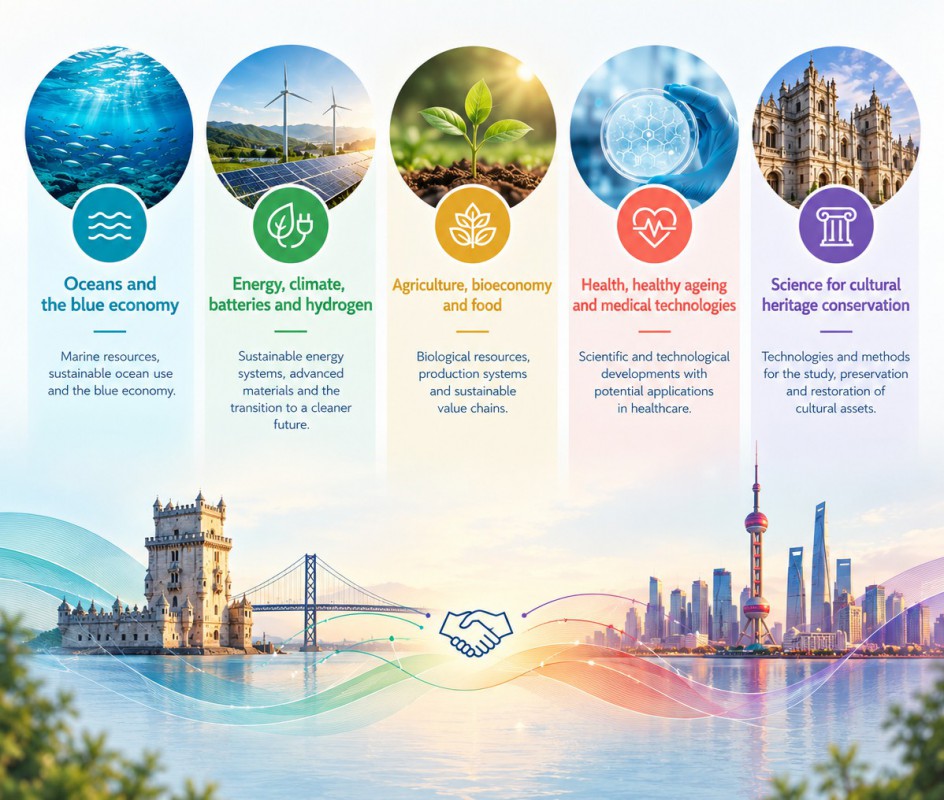
The Joint Declaration identifies five areas for bilateral scientific and technological cooperation:
-
Oceans and the blue economy, including research related to marine resources and sustainable ocean use.
-
Energy, climate, batteries and hydrogen, addressing challenges in energy systems, materials and the transition towards more sustainable technologies.
-
Agriculture, the bioeconomy and food, supporting research on biological resources, production systems and sustainable value chains.
-
Health, healthy ageing and medical technologies, encompassing scientific and technological developments with potential applications in healthcare.
-
Science for cultural heritage conservation, bringing scientific methods and technologies to the study, preservation and restoration of cultural assets.
These priorities provide a shared framework for identifying areas of mutual interest, developing collaborative research activities and connecting complementary expertise across the two countries. Although materials science is not identified as a separate priority, it cuts across several of the themes, particularly energy, health, the bioeconomy and sustainable technologies.
CICECO’s research aligns with several priorities
CICECO's four research lines offer clear points of connection with the priorities identified in the Joint Declaration.
The Energy line, coordinated by Filipe Figueiredo, focuses on energy production, conversion and storage. Its research includes fuel cells, lithium-, sodium- and magnesium-ion batteries, supercapacitors and green hydrogen, directly aligning with the bilateral priority on energy, climate, batteries and hydrogen.
The Health line, coordinated by Mariana Oliveira, develops innovative biomaterials and therapeutic molecules and undertakes the pre-clinical validation of medical and pharmaceutical products and devices. These activities connect with the priority on health, healthy ageing and medical technologies.
The Sustainability line, coordinated by Carla Vilela, focuses on renewable raw materials, resource efficiency and the circular economy. Its research is relevant to the bioeconomy priority and to the development of more sustainable materials and production processes.
The Digitisation line, coordinated by Vítor Sencadas, investigates advanced materials for photonics, sensors, actuators, nanotechnology and artificial intelligence. These areas provide additional opportunities for scientific and technological collaboration, extending beyond the five priorities explicitly identified in the declaration.
Together, these research activities position CICECO to explore potential partnerships with Chinese institutions as the bilateral framework moves towards implementation. The extent of these opportunities will depend on the specific research topics, funding instruments and partnership arrangements established by the two countries.
An existing relationship with Chinese research institutions
Cooperation with China is not new for CICECO and the University of Aveiro. In October 2025, University of Aveiro researchers took part in a conference of the ECUST–UAveiro Joint Research Center for Sustainable Chemistry and Materials, held at the East China University of Science and Technology (ECUST) in Shanghai.
The centre was established through an agreement signed earlier that year between the two universities. It aims to promote joint research, educational cooperation and technology transfer in areas including renewable chemical processes, biodegradable materials and circular economy approaches. The initiative provides an institutional basis for researchers from both countries to develop shared research activities and strengthen scientific networks.
More recently, CICECO hosted a delegation of students from Zhejiang University for a two-day programme. The visit included laboratory tours, a student research workshop, flash talks by CICECO researchers, and visits to companies and industrial partners in the region. Followed by the professors from the university, who also came for a technical visit.
These activities have helped researchers and students exchange knowledge, explore complementary expertise and establish connections between scientific communities. They also provide a practical foundation for future collaborations in which research, education and industry can contribute to shared scientific and technological objectives.
How could researchers collaborate?
While the Joint Declaration establishes the strategic direction for cooperation, the practical arrangements remain to be defined. Portuguese and Chinese authorities plan to examine possible mechanisms through technical discussions in 2027. These may include:
-
Joint research funding, through bilateral mechanisms supporting collaborative research and innovation projects.
-
Researcher mobility, enabling researchers to work with partner institutions and develop scientific networks.
-
Institutional and industrial partnerships, supporting technological cooperation between scientific institutions and companies.
-
Joint research structures, including networks of laboratories and research consortia that bring together expertise from both countries.
No specific funding amounts, calls for proposals or project deadlines have yet been announced in the Joint Declaration. Researchers interested in future opportunities should therefore distinguish between the strategic framework already agreed and the funding instruments that remain under development.
For CICECO, the combination of established institutional links, complementary research expertise and experience in international collaboration offers a starting point for identifying potential partners and preparing for future initiatives. Existing cooperation with ECUST and exchanges with Zhejiang University illustrate how scientific relationships can develop through research activities, academic visits and institutional agreements.
The declaration also emphasises that scientific cooperation should be safe, transparent and reciprocal, respecting academic freedom, scientific integrity and the legislation applicable in each country, including European requirements in Portugal.
Academic mobility and doctoral cooperation
The renewed scientific dialogue is also intended to strengthen connections between research and higher education. Portugal and China have agreed to pursue opportunities for academic mobility and joint supervision of doctoral programmes.
In parallel, negotiations are expected to resume in 2027 on a new agreement for the mutual recognition of higher education degrees and diplomas, replacing the agreement dating from 2005. A new arrangement could facilitate the movement of students and researchers between the two countries by clarifying the recognition of academic qualifications.
The two countries are also preparing a joint action plan for higher education covering 2027–2030, with further discussions planned on institutional partnerships, advanced training and other areas of academic cooperation.
These developments could support research organisations seeking to establish longer-term international partnerships, develop doctoral training opportunities and strengthen links between scientific communities. For CICECO, academic mobility and joint supervision could complement existing research collaborations by creating opportunities for early-career researchers and students to work across institutions.
From political agreement to research opportunities
The Joint Declaration provides for technical meetings in 2027 and anticipates that Portugal will host the 11th meeting of the Joint Commission on Science and Technology in 2028.
The next phase will be decisive in determining how the agreed priorities translate into research projects, funding opportunities and lasting institutional partnerships. For CICECO, the framework represents a potential opportunity to build on existing connections with Chinese institutions and explore new collaborations across energy, health, sustainability and advanced materials.
As the two countries move towards defining the practical instruments for cooperation, following these developments will be important for researchers seeking to identify complementary expertise, establish partnerships and contribute to shared scientific and technological goals.
Related Articles


Researchers

Vitor Sencadas
Associate Professor
Filipe Miguel H Lebre R Figueiredo
Principal Researcher
Carla Vilela
Assistant Professor
Mariana B. Oliveira
Assistant ResearcherWe use cookies for marketing activities and to offer you a better experience. By clicking “Accept Cookies” you agree with our cookie policy. Read about how we use cookies by clicking "Privacy and Cookie Policy".