

2 September 2026
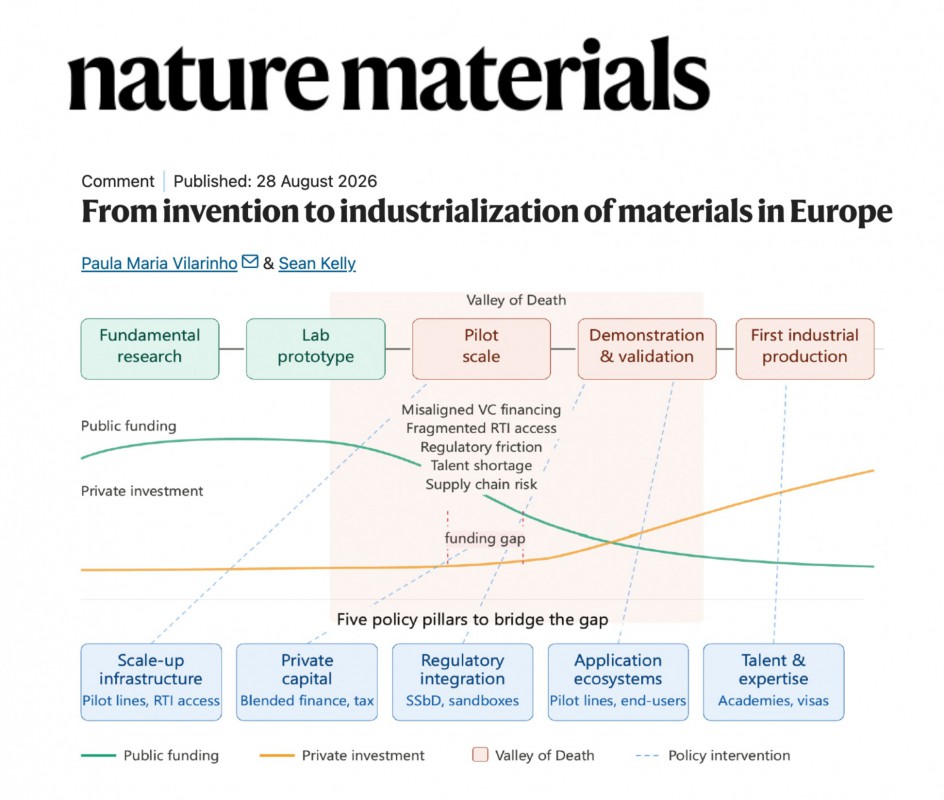
A new Comment published in Nature Materials by Paula Maria Vilarinho, from CICECO and the Department of Materials and Ceramic Engineering at the University of Aveiro, and Sean Kelly, from the Nanotechnology Industries Association, addresses one of the central challenges facing advanced materials in Europe: how to transform scientific discoveries into industrial technologies and products.
Published online on 28 August 2026, the article, entitled From invention to industrialization of materials in Europe, argues that Europe has a strong position in fundamental materials research, but continues to face structural difficulties in scaling up technologies and bringing them to the market.
The authors point to a persistent gap between laboratory research and industrial production. Materials technologies often require long development periods, specialised infrastructure and substantial investment, making the transition from laboratory prototypes to industrial production particularly challenging. The article identifies this stage as a “valley of death”, where financing, infrastructure, regulation, skills and industrial capabilities can limit the progression of promising technologies.

The Comment draws on discussions held during the Future of Advanced Materials in Europe (FAME) Workshop, organised at the University of Aveiro in November 2025, which brought together representatives from industry, research, investment, regulation and policymaking. The workshop highlighted the need for a stronger connection between research excellence and industrial deployment.
For the authors, addressing this challenge requires a coordinated European approach. Among the priorities identified are greater access to pilot and scale-up infrastructure, new mechanisms to mobilise private investment, a more integrated regulatory framework, stronger links between materials developers and industrial end users, and investment in specialised skills for materials industrialisation.
“Europe has the scientific depth, the regulatory credibility and the industrial base to be a leader. However, the continent has lacked a coherent framework to convert these assets into manufactured products,” adds Dr. Vilarinho.
The article also emphasises that advanced materials should be developed with their applications and industrial context in mind. Rather than focusing exclusively on the properties of a new material, the authors argue for application-driven ecosystems in which materials developers, end users and industrial partners work together to validate technologies under realistic manufacturing conditions.
The publication also reinforces the relevance of the recently created CICECO Materials Observatory, an initiative designed to connect expertise in materials science with strategic challenges involving industry, policymakers and society. The Observatory provides evidence-based analysis on scientific, technological and societal issues related to materials and translates scientific knowledge into outputs such as position papers, policy briefs and expert reports.
“The Materials Observatory was created to contribute scientific evidence to discussions about the strategic role of materials in society, industry and public policy. The publication in Nature Materials is an opportunity to extend this dialogue and to highlight the importance of connecting scientific excellence with the conditions required for industrial deployment and technological competitiveness,” highlights Dr. Vilarinho.
The Observatory already includes contributions addressing the strategic role of advanced materials in Portugal and Europe, including a roadmap by Paula M. Vilarinho on Portugal’s opportunities in the European advanced materials landscape, as well as the FAME Workshop report.
The publication in Nature Materials extends this discussion to an international audience and places the challenges identified through the FAME initiative within the broader European debate on advanced materials policy and industrial competitiveness.
As Europe prepares the 2026 Advanced Materials Act, Vilarinho and Kelly argue that the success of European materials policy should ultimately be measured not only by scientific publications or patents, but by Europe’s capacity to produce and deploy advanced materials safely, sustainably and at scale.
Related Articles

Researchers

Paula Maria Lousada Silveirinha Vilarinho
Vice DirectorWe use cookies for marketing activities and to offer you a better experience. By clicking “Accept Cookies” you agree with our cookie policy. Read about how we use cookies by clicking "Privacy and Cookie Policy".