

4 September 2026

The University of Aveiro (UA) has completed its coordination of the training programme under the “New Space Portugal” Mobilising Agenda. With an investment of €312,000, the project leaves a national training network and the “Aero Arena” laboratory as a lasting legacy. These resources aim to address the shortage of specialised human resources and strengthen the national aerospace ecosystem.
A national network for aerospace training, applied research and dissemination
As part of the New Space Portugal Mobilising Agenda, UA consolidated the development of an integrated national network for training, applied research and dissemination in the aerospace field. The network involved key partners such as the Portuguese Air Force Academy (AFA), Instituto Superior Técnico (IST), the University of Beira Interior (UBI), the University of Évora, the University of Minho, the Faculty of Engineering of the University of Porto (FEUP) and NOVA School of Business & Economics (NOVA SBE).
Since July 2022, UA has assumed the technical and scientific coordination of PPS5 (Education and Training Programme) and WP6 (Training and Human Resources Capacity Building), within a €451.9 million consortium comprising 41 co-promoters and led by GEOSAT.
Under the scientific coordination of Nuno Borges de Carvalho, lecturer at the Department of Electronics, Telecommunications and Informatics (DETI), the main objective was to design new specialised training pathways and advanced training programmes in critical areas of the aerospace sector. These programmes draw on the specific expertise of each partner institution to attract and train professionals and companies in the sector.
“Aero Arena” laboratory establishes a technological legacy on campus
With the main R&D activities completed on 30 June 2026, the practical impact of the Agenda was materialised on the UA campus through the creation of the Aero Arena Laboratory / Aerospace Engineering Laboratory. This technological infrastructure is equipped with OptiTrack systems, an Air Bearing platform, CubeSats, CANSATs and UAVs, and is fundamental for experimental teaching, applied research, space systems validation, aerospace platform testing and demonstration activities.
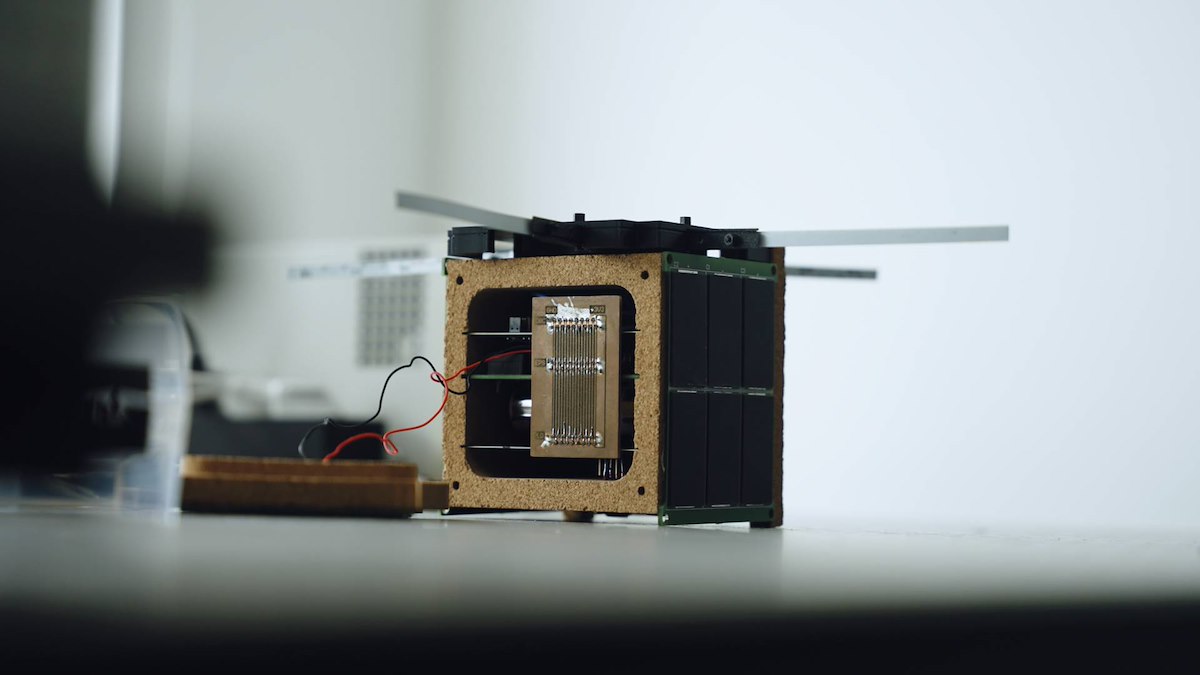
The laboratory also provided the basis for the development of CorkSat – The Aveiro CubeSat. This small satellite stands out for its pioneering use of cork and is intended for teaching, research, experimental validation and technology transfer.
For Nuno Borges de Carvalho, this represents the main legacy and continuity milestone of the Agenda at the University: “We have created a permanent foundation for aerospace training and experimentation, capable of training, attracting and retaining talent in Portugal, bringing students, researchers and companies together around concrete space projects.”

Advanced training responds to industry needs
Internally, the project consolidated UA’s Master’s Degree in Aerospace Engineering, which welcomes around 25 students each year. It also enabled the launch of new micro-credentials and training content in areas including satellite communications, satellite systems, microwaves, instrumentation, microwave measurements and positioning.
This educational offer responds directly to the urgent demand from the Portuguese aerospace industry for expertise in satellite systems, space communications, radio frequency, microwaves, sensors, UAVs, experimental validation, embedded systems and dual-use technologies for civilian and military applications.
UA’s approach combines theory with laboratory experimentation. According to the coordinator, this model enables students to design, test and validate solutions in a laboratory environment, “bringing university training closer to the real needs of industry, where engineers are required to integrate systems, operate equipment, develop prototypes and participate in space, aeronautical and defence missions.”
Campus connected to the global ecosystem
The work brought together lecturers, researchers and students from DETI, the School of Design, Management and Production Technologies of Aveiro (ESAN) and the Telecommunications Institute (IT) in a multidisciplinary approach.
The project also supported internationally oriented events such as Aveiro Space Week and Aveiro Space and Defence Week, as well as activities involving CANSATs, dual-use technologies and participation in the ESA Academy Concurrent Engineering Challenge.
The New Space Portugal Agenda is one of the 21 Mobilising/Green Agendas for Business Innovation funded by the Recovery and Resilience Plan (RRP) in which UA participates. Further information on these Agendas is available online.
Related Articles

Researchers
J. Martinho Oliveira
Coordinator ProfessorWe use cookies for marketing activities and to offer you a better experience. By clicking “Accept Cookies” you agree with our cookie policy. Read about how we use cookies by clicking "Privacy and Cookie Policy".