

9 October 2026

The QuantumPUF project officially kicked off in late September, with the support of CICECO – Aveiro Institute of Materials at the University of Aveiro (UA). The European research initiative aims to develop a new generation of authentication technologies based on photonic materials and quantum principles, addressing cybersecurity challenges associated with increasingly sophisticated counterfeiting and the future impact of quantum computing.
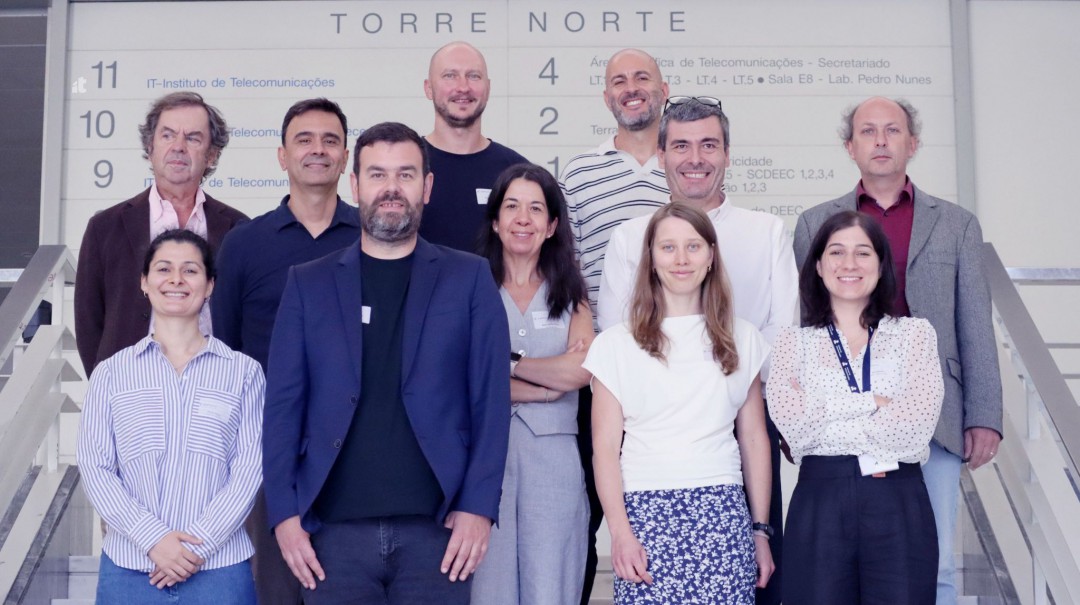
Coordinated by the Instituto de Telecomunicações (IT) in Portugal, QuantumPUF brings together a multidisciplinary consortium of research institutions and companies from across Europe. The partners include the University of Aveiro, Humboldt-Universität zu Berlin, Universidad de Vigo, Université de Genève, Research and Innovation Services (RISE) and AdvayaTech.
The University of Aveiro team includes Rute Ferreira, Luís Carlos, Vítor Sencadas, Carlos Brites and Lianshe Fu, contributing expertise in materials science and related research areas to the development of the project's authentication technologies.
QuantumPUF focuses on Physical Unclonable Functions (PUFs), which use distinctive physical characteristics of materials and devices to generate authentication signatures that are difficult to reproduce. These technologies could provide an additional layer of protection for electronic devices, supply chains and connected systems.
To achieve this, researchers will develop luminescent materials capable of generating unique optical signatures. The project will investigate how properties such as emission lifetime, spectral signatures and spatial disorder can encode authentication information across different physical dimensions.
The consortium will develop three classes of photonic PUFs: classical PUFs, quantum-readout PUFs and quantum PUFs. Two complementary material platforms will be investigated: layered organic–inorganic hybrid nanoparticles and lanthanide-based coordination complexes.
Another objective is to explore practical ways of reading these optical signatures. The project will investigate secure optical readout using CMOS sensors and portable systems, with the longer-term possibility of integrating authentication technologies into smartphones.
Security assessments will also play a central role, combining theoretical and experimental approaches to evaluate vulnerabilities and develop quantum cryptographic certification methods.
By bringing together expertise in photonics, materials engineering and quantum cryptography, QuantumPUF aims to advance secure authentication technologies towards practical applications, including device authentication, anti-counterfeiting and the protection of digital infrastructure.
Funded by the European Union through the Horizon Europe programme, QuantumPUF (project 101258015) will run from September 2026 to August 2030.
Follow the project’s progress:
Website: https://quantumpuf.eu/
LinkedIn: https://www.linkedin.com/showcase/quantumpuf/
Related Articles



Researchers

Maria Rute de Amorim e Sá Ferreira André
Full professor
Luís Carlos
Full professor
Carlos Brites
Associate Professor
Lianshe Fu
Junior Researcher
Vitor Sencadas
Associate Professor




We use cookies for marketing activities and to offer you a better experience. By clicking “Accept Cookies” you agree with our cookie policy. Read about how we use cookies by clicking "Privacy and Cookie Policy".