





Scientific Interests
1. High-temperature thermoelectric harvesting of waste heat and renewable energy.
 Rapid development of high-temperature thermoelectric conversion is of special importance for green energy sector, in particular, by enabling self-sufficient technologies for mobile sectors or remote applications, and hybrid solutions involving thermoelectric modules. Among those applications, which are now considered most prospective, some can be highlighted, as conversion of the concentrated solar radiation, combination with photovoltaic systems and heat recovery from automotive exhaust. A broad impact is expected from the use of oxide-based thermoelectrics, provided by their natural abundance, environmental benefits and capability of operating at high temperatures, as an alternative to traditional Bi2Te3, Bi2Se3, PbTe –based thermoelectrics.
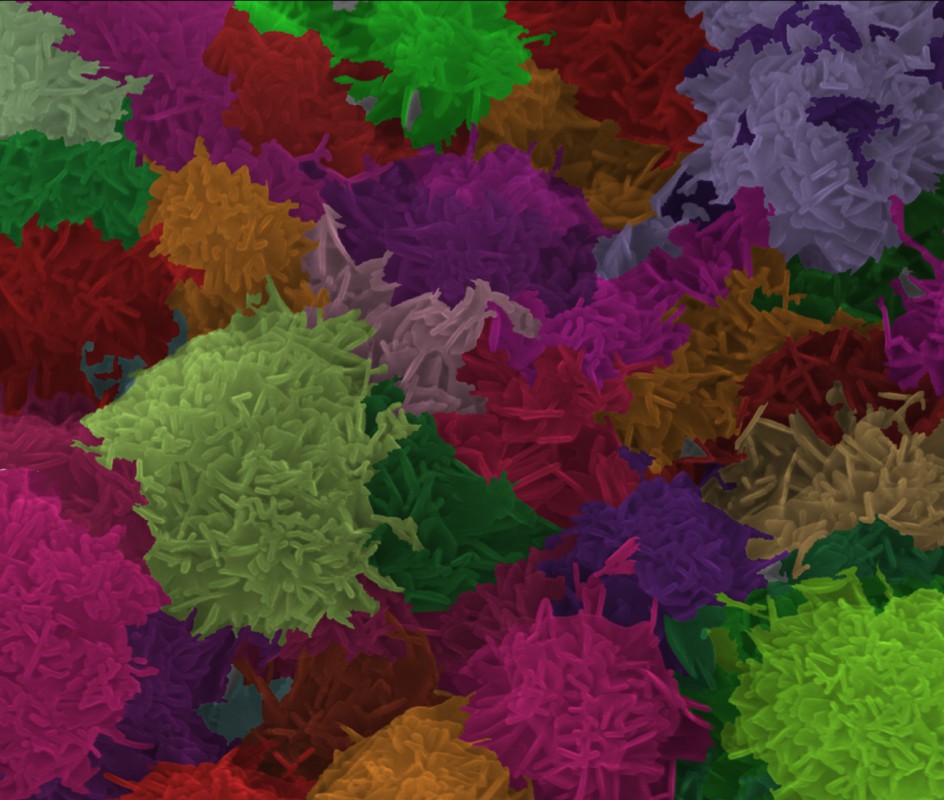
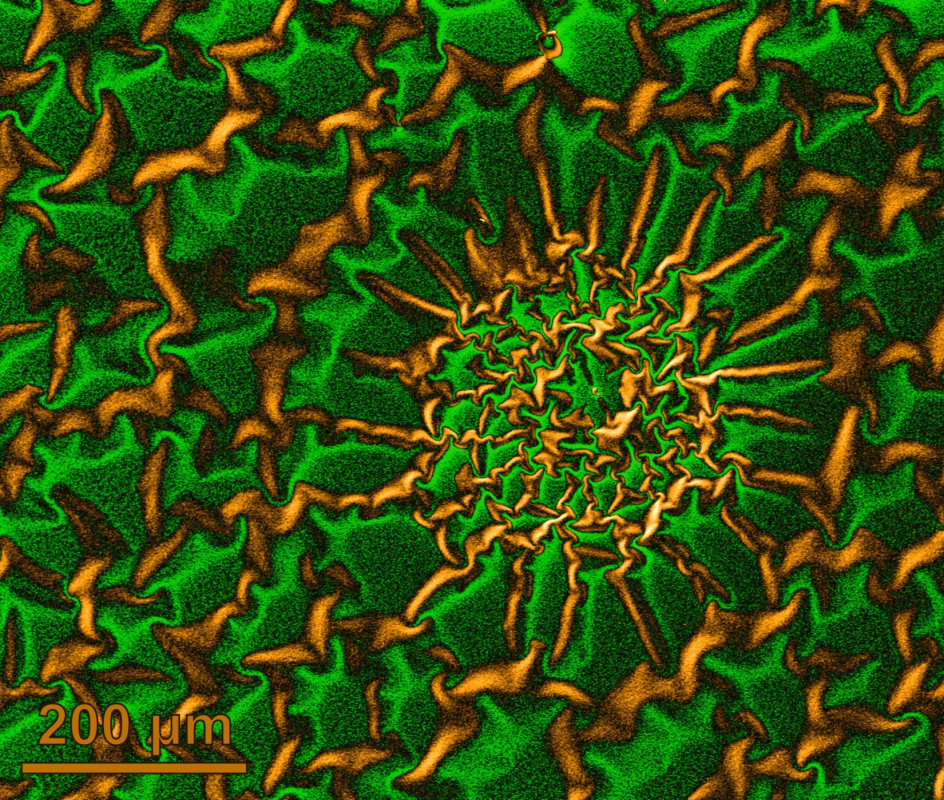
The research is mainly focused at oxide thermoelectric materials including donor-substituted strontium titanate-based materials, ZnO-based composites and various layered cobaltites. The main approaches include:
- Defect chemistry engineering, aimed at deliberate creation of the lattice defects, which result in enhanced phonon scattering and higher mobility of the charge carriers.
- Redox-induced nanostructuring and creation of compositional inhomogeneities (core-shell microstructures) for suppressing the thermal conductivity and faster electronic transport at the grain boundaries.
- Laser floating zone processing for oxide thermoelectrics, in order to create unique micro-/nanostructural features, triggering high thermoelectric performance.
Key publications:
1. A.V. Kovalevsky*, K.V. Zakharchuk, M.H. Aguirre, W. Xie, S.G. Patrício, N.M. Ferreira, D. Lopes, S.A. Sergiienko, G. Constantinescu, S.M. Mikhalev, A. Weidenkaff, J.R. Frade, Redox engineering of strontium titanate-based thermoelectrics, 2020, J. Mater. Chem. A, vol. 8, p. 7317 (doi: https://doi.org/10.1039/C9TA13824B)
1. K.V. Zakharchuk, M. Widenmeyer, D.O. Alikin, W. Xie, S. Populoh, S.M. Mikhalev, A. Tselev, J.R. Frade, A. Weidenkaff, A.V. Kovalevsky*, A self-forming nanocomposite concept for ZnO-based thermoelectrics, J. Mater. Chem. A, 2018, vol. 6, pp.13386-13396 (https://doi.org/10.1039/C8TA01463A)
2. A.A. Yaremchenko, S. Populoh, S.G. Patrício, J. Macías, P. Thiel, D.P. Fagg, A. Weidenkaff, J.R. Frade, A.V. Kovalevsky*, Boosting thermoelectric performance by controlled defect chemistry engineering in Ta-substituted strontium titanate, Chem. Mater., 2015, vol. 27, pp. 4995-5006. (https://doi.org/10.1021/acs.chemmater.5b01389)
2. Functional porous cellular ceramics for catalytic and separation applications.
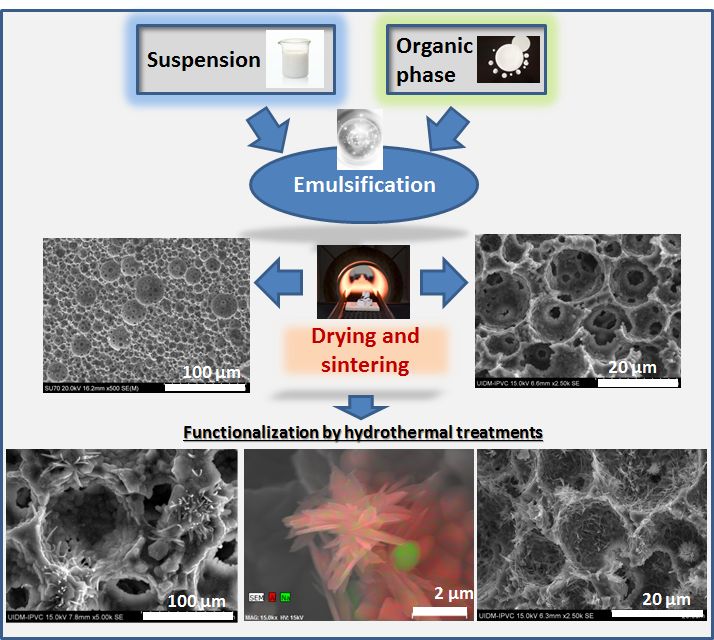
Functional materials with controlled dimensionality and morphology are recognized as an essential part of numerous engineering solutions for energy, food, water and environmental problems. Those possessing large surface areas, tunable pore size, appropriate thermal stability and tailored acid/basic functionalities, allowing modification with catalytically active species, are of particular interest for both technology and fundamental research. Although many catalytic processes and related materials have already been discovered and improved during the last century, still many opportunities exist both for development of new approaches and even for new solutions in mature technologies.
The research is focused on the processing and bulk functionalization of the monolithic cellular ceramics for catalytic and separation applications. The main approaches include:
- Processing of porous cellular ceramics through emulsification of ceramic suspensions.
- Modification of the pores with nanostructured functional materials via hydrothermal treatment.
- In-situ modification of the pores with nanostructured transition metals for catalytic applications.
Key publications:
1. Y.A. Ivanova*, C. Freitas, D.V. Lopes, A.V. Kovalevsky, J.R. Frade, Cellular zirconia ceramics processed by direct emulsification, J. European Ceram. Soc., 2020, vol. 40, pp. 2056-2062 (doi: 10.1016/j.jeurceramsoc.2020.01.005)
2. M. Baptista, A.V. Kovalevsky*, A.R. Sarabando, M.C. Ferro, I. Capela, J.R. Frade, Highly-porous mayenite-based ceramics by combined suspension emulsification and reactive sintering, Mat. Lett., 2019, vol. 237, pp. 41-44 (doi: 10.1016/j.matlet.2018.11.061)
3. E. Lalli, N.M.D. Vitorino, C.A.M. Portugal, J.G. Crespo, C. Boi, J.R. Frade, A.V. Kovalevsky*, Flexible design of cellular Al2TiO5 and Al2TiO5 – Al2O3 composite monoliths by reactive firing, Materials and Design, 2017, vol. 131, pp. 92-101 (doi: 10.1016/j.matdes.2017.06.010)
3. Carbon-lean technologies for metal extraction.
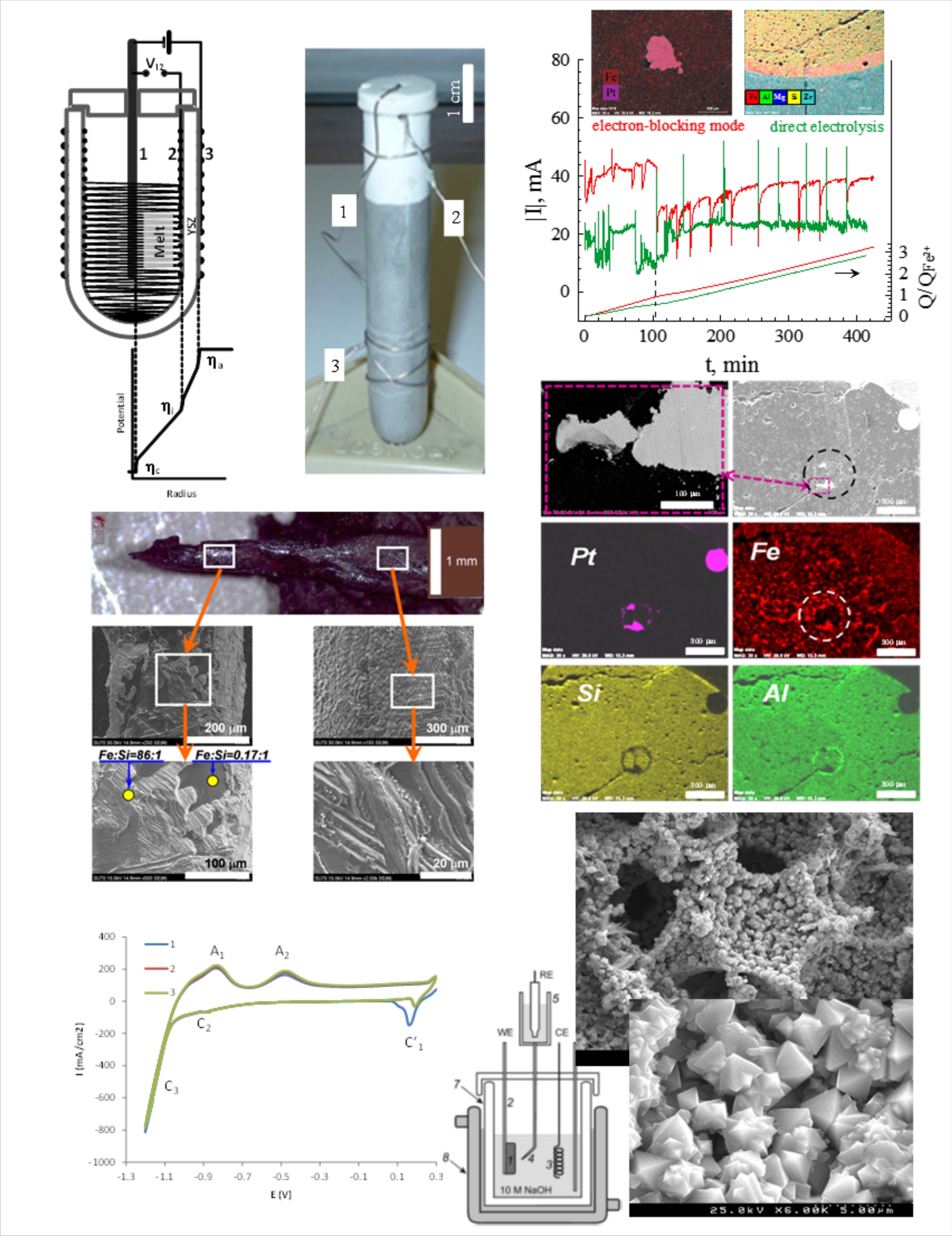 Although classical extractive metallurgy is well-established, and energy consumption per tonne of produced steel has been reduced by 50% in recent years, this sector is now facing stronger pressure to lower greenhouse gas emissions, and to comply with stricter international regulations. Thus, from a broad environmental perspective, one seeks new strategies for carbon-lean iron extraction, with emphasis on electrolysis.
The research is focused on less common technologies of direct electrochemical reduction of metal oxides and pyroelectrolysis. The main research directions include:
- Demonstration of the concept for iron pyroelectrolysis in magnesium aluminosilicate melts.
- Electrolytic in-situ reduction of iron oxides and ferrospinels in alkaline medium.
Key publications:
1. D.V. Lopes, Y.A. Ivanova*, A.V. Kovalevsky, A.R. Sarabando, J.R. Frade, M.J. Quina, Electrochemical reduction of hematite-based ceramics in alkaline medium: Challenges in electrode design, Electrochim. Acta, 2019, vol. 327, p. 135060 (doi: 10.1016/j.electacta.2019.135060)
2. J.F. Monteiro, Yu.A. Ivanova*, A.V. Kovalevsky, D.K. Ivanou, J.R. Frade, Reduction of magnetite to metallic iron in strong alkaline medium, Electrochim. Acta, 2016, vol. 193, pp. 284-292. (https://doi.org/10.1016/j.electacta.2016.02.058)
3. N.M. Ferreira, A.V. Kovalevsky*, S.M. Mikhalev, F.M. Costa, J.R. Frade, Prospects and challenges of iron pyroelectrolysis in magnesium aluminosilicate melts near minimum liquidus temperature, Phys. Chem. Chem. Phys., 2015, vol. 17, pp. 9313-9325. (https://doi.org/10.1039/c5cp00858a)
4. Mixed ionic-electronic conductors for high- and intermediate temperature electrochemical applications.
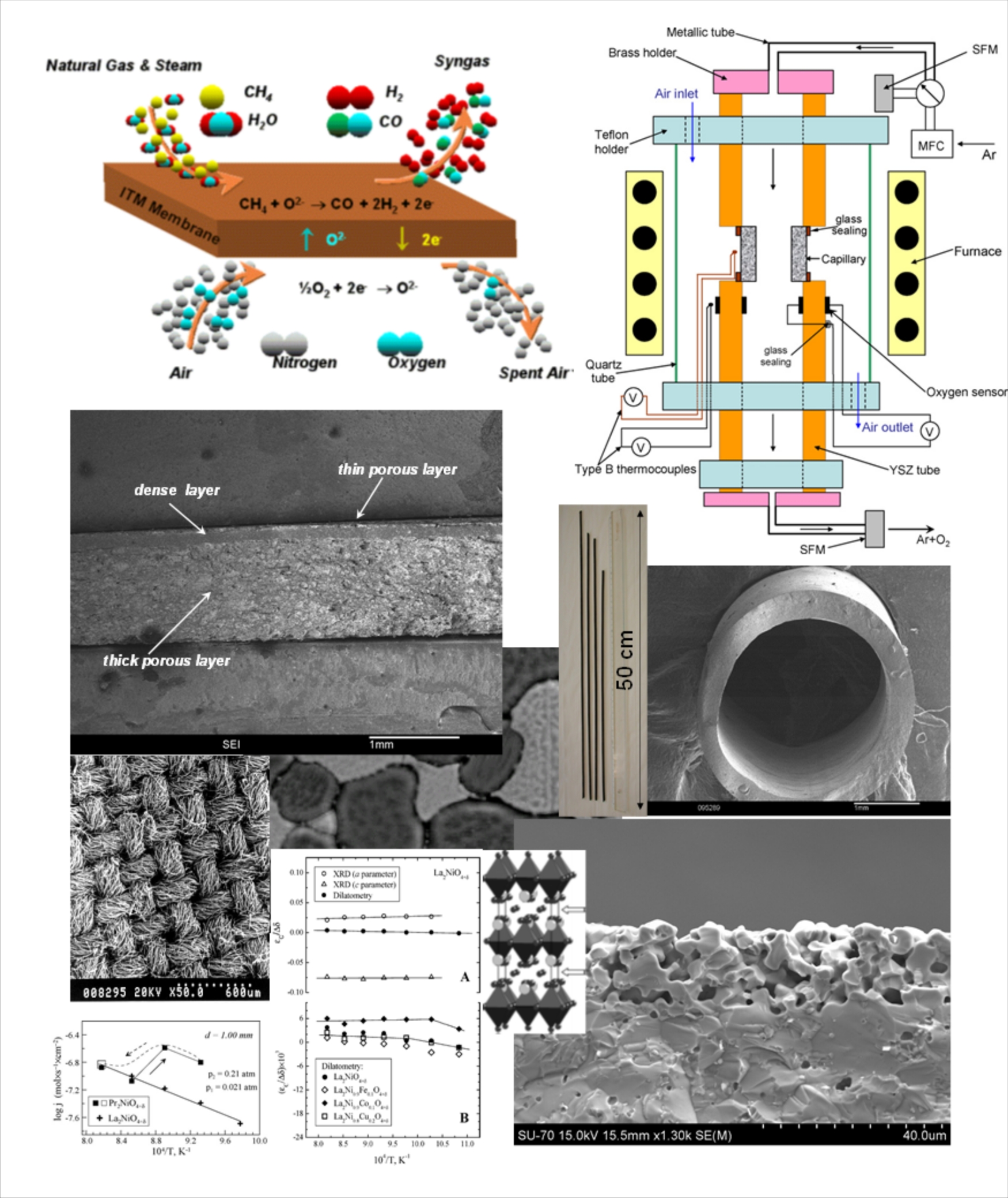 Mixed ionic-electronic conductors (MIECs) have been and continue to be of a strategic interest for various energy conversion applications, chemical production and environmental monitoring. These include fuel cells, oxygen permeation membranes, proton-conducting ceramic membranes, batteries and sensors. In a solid oxide fuel cell (SOFC) concept, the MIEC materials provide an enhancement of oxygen reduction reaction kinetics at the cathode, thus facilitating lower-temperature operation and enabling faster start-up times, improved stability and easier thermal management. The use of MIEC oxygen membranes has attracted much attention due to simplicity in construction and operation of reactors for partial oxidation of hydrocarbon feedstock. A dense MIEC membrane delivers pure oxygen from air to the hydrocarbon feed stream, driven by the gradient in partial pressure of oxygen across the membrane. The flux of oxygen-related defects (oxygen vacancies or interstitials) is compensated by a flux of electronic charge carriers. The aim to realize high oxygen fluxes through such membranes requires both fast surface oxygen exchange and ion diffusion in the bulk, achievable via structural tuning of the MIEC materials and design of the membrane architecture.
The research is focused both on the development of new materials with enhanced ionic transport properties and improved thermochemical stability, and conceptual solutions for membrane design. The main research directions include:
- Various substitution approaches for improving ionic transport, oxygen exchange kinetics, redox stability and suppressing the chemical expansion in perovskite- and K2NiF4-type materials.
- Assessment of asymmetric flat and tubular (hollow-fibre) membrane geometries for oxygen separation process.
Key publications:
1. N. Nasani, D. Pukazhselvan, A.V. Kovalevsky, A.L. Shaula, D.P. Fagg*, Conductivity recovery by redox cycling of yttrium doped barium zirconate proton conductors and exsolution of Ni-based sintering additives, J. Power Sources, 2017, vol. 339, pp. 93-102. (https://doi.org/10.1016/j.jpowsour.2016.11.036)
2. A.V. Kovalevsky*, A.A. Yaremchenko, V.A. Kolotygin, A.L. Shaula, V.V. Kharton, F.M.M. Snijkers, A. Buekenhoudt, J.R. Frade, E.N. Naumovich, Processing and oxygen permeation studies of asymmetric multilayer Ba0.5Sr0.5Co0.8Fe0.2O3-d membranes, J. Membr. Sci., 2011, vol. 380, pp. 68-80.
(doi: https://doi.org/10.1016/j.memsci.2011.06.034)
3. C. Buysse*, A. Kovalevsky, F. Snijkers, A. Buekenhoudt, S. Mullens, J. Luyten, J. Kretzschmar, S. Lenaerts, Development, performance and stability of sulphur-free, macrovoid-free BSCF capillaries for high temperature oxygen separation from air, J. Membr. Sci., 2011, vol. 372, p. 239-248. (doi: https://doi.org/10.1016/j.memsci.2011.02.011
Ongoing Supervisions
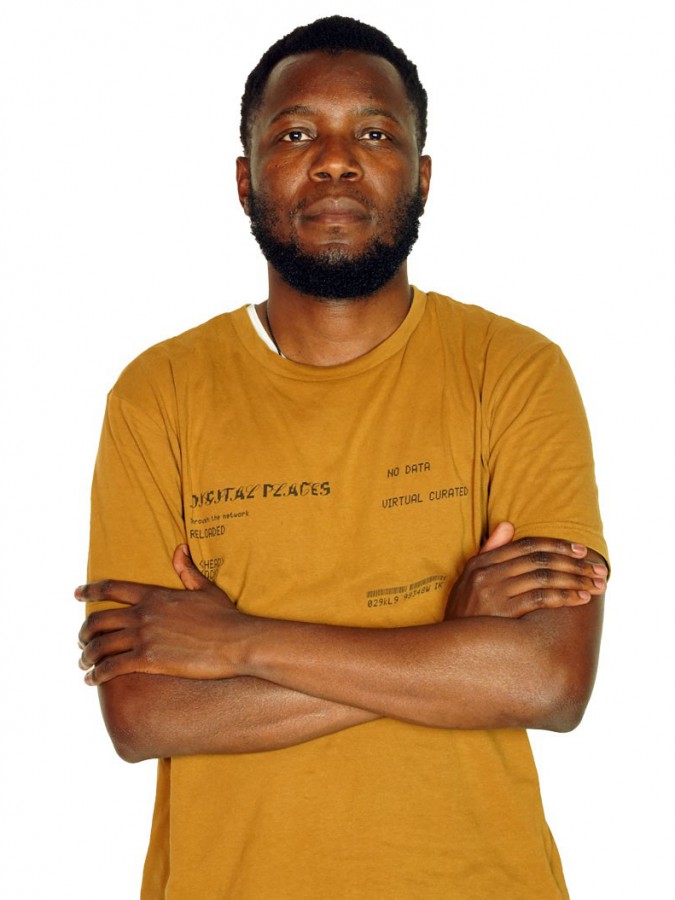
Adélio Fumo
PhD Student
Miguel Amado Vieira
PhD StudentProjects
Caracterizacao da conducao termica em nanoescala utilizando metodos de varrimento de sonda para guiar a sintese de ceramicas termoeletricas (NANOCERAMPROBE)
PartnerFundação para a Ciência e a Tecnologia
thermoelectrics; scanning probe microscopy; thermal conduction; microstructureCellular oxide catalysts for emission lean combustion in porous media (LEANCOMB)
PartnerFundação para a Ciência e a Tecnologia
cellular ceramics, combustion, catalysts, functionalizationDesign de materiais termoeletricos avancados por efeitos redox: Progressos para aplicacoes de alta temperatura . (REMOTE)
PartnerFundação para a Ciência e a Tecnologia
Development of new methodologies for industrial CO2-free steel production by electrowinning (SIDERWIN)
Local CoordinatorEuropean Comission
For the time being, there are no economically feasible steelmaking technologies available having the potential to meet the EU’s climate and energy targets for 2030. At best, a 15% decrease in the overall CO2 intensity of the sector could be achieved throughout the widespread dissemination of technologies that could reasonably become co...Facing the challenges of characterizing novel thermal materials and processes (Heat@UA) (RECI/CTM-CER/0336/2012)
PartnerFundação para a Ciência e a Tecnologia
Thermal properties of materials Thermal processes Thermometry Nano-scale studiesNovel approach to Power-to-Fuel: comprehensive studies of anodic processes in Direct Carbon Solid Oxide Fuel-assisted Electrolysis Cell (DC-SOFEC)
PartnerOther International
Novel layered ferrits materials with mixed ionic-electronic conductivity for applications in alternative energy sources (PTDC/CTM/64357/2006)
PartnerFundação para a Ciência e a Tecnologia
Mixed conductors Ceramic membranes SOFC electrodes Ionic TransportNovel molten carbonate/ceramic composite materials for sustainable energy technologies with. CO2 capture and utilization (MOCO3)
PartnerFundação para a Ciência e a Tecnologia
The MOCO3 project focuses on the development of novel composite materials consisting of molten carbonates infiltrated in a solid matrix as functional materials in intermediate temperature fuel cells and CO2 selective membranes. MOCO3 addresses performance and lifetime of these systems by focusing on materials engineering at all length scales (at...Novos conceitos de catalisadores para oxi-vapor gasificação de biomassa sem alcatrões. (NOTARGAS)
PartnerFundação para a Ciência e a Tecnologia
Produção de hidrogénio verde impulsionada por Mxenes (HydroXen)
CoordinatorOther National
Este projeto de prova de conceito reconhece os resultados promissores do projeto precedente SusPhotoSolutions em relação aos novos conceitos do elétrodo para reação de evolução de hidrogénio (HER), um componente cr...SGH : Smart Green Homes (Smart Green Homes)
PartnerIndustry National
The Smart Green Homes (SGH) Project aims to develop integrated product and technology solutions for the households, raising standards of comfort, safety and user satisfaction to a new level and, at the same time, to respond to the problems of sustainability of the Planet, increasing the energy efficiency and reducing the emission of gaseous poll...Thermoelectric oxide composites: design through controlled interactions (TEOsINTE)
CoordinatorEuropean Comission
Thermoelectric (TE) materials can convert temperature differences directly into electricity and are nowadays considered as one of the most promising means to produce “green” electricity from the huge amount of various available waste heat sources. TE conversion is intrinsically simple, scalable and reliable, empl...Towards highly-efficient oxide thermoelectrics by structural and defects engineering (Programme for Cooperation in Science between Portugal and Germany - 441.00)
CoordinatorFundação para a Ciência e a Tecnologia
Unitised regenerative fuel cell for efficient renewable energy supply: from materials to device (SAICTPAC/0032/2015)
PartnerFundação para a Ciência e a Tecnologia
Energia; Hidrogénio; Pilha de combustível; ElectrolisadorZero CO2 emissions: challenge and foresight for innovative multi-ionic functional membranes (CO2zero)
PartnerFundação para a Ciência e a Tecnologia
Publications
Defect formation and transport in La0.95Ni0.5Ti0.5O3-delta
Yakovlev, SO; Kharton, VV; Naumovich, EN; Zekonyte, J; Zaporojtchenko, V; Kovalevsky, AV; Yaremchenko, AA; Frade, JR
2006, SOLID STATE SCIENCES, 8, 11, 1302-1311.
Oxygen evolution on perovskite-type cobaltite anodes: an assessment of materials science-related aspects
Kovalevsky, AV; Sviridov, DV; Kharton, VV; Naumovich, EN; Frade, JR
2006, ADVANCED MATERIALS FORUM III, PTS 1 AND 2, 514-516, 377-381.
Processing and characterization of La0.5Sr0.5FeO3-supported Sr1-xFe(Al)O-3-SrAl2O4 composite membranes
Kovalevskya, AV; Kharton, VV; Maxim, F; Shaula, AL; Frade, JR
2006, JOURNAL OF MEMBRANE SCIENCE, 278, 1-2, 162-172.
Glass-ceramic sealants for SOFC-based systems
Kharton, VV; Tsipis, EV; Carvalho, AP; Kovalevsky, AV; Naumovich, EN; Marques, FMB; Frade, JR; Shaula, AL
2005, Fuel Cell Technologies: State and Perspectives, 202, 231-238.
ISBN:
1-4020-3496-2
Mixed conducting materials for partial oxidation of hydrocarbons
Frade, JR; Kharton, VV; Yaremchenko, AA; Tsipis, EV; Shaula, AL; Naumovich, EN; Kovalevsky, AV; Marques, FMB
2004, BOLETIN DE LA SOCIEDAD ESPANOLA DE CERAMICA Y VIDRIO, 43, 3, 640-643.
Phase interaction and oxygen transport in oxide composite materials
Shaula, AL; Kharton, VV; Marques, FMB; Kovalevsky, AV; Viskup, AP; Naumovich, EN
2004, BRITISH CERAMIC TRANSACTIONS, 103, 5, 211-218.
Oxygen permeability of transition metal-containing La(Sr,Pr)Ga(Mg)O3-delta ceramic membranes
Yaremchenko, AA; Shaula, AL; Kharton, VV; Kovalevsky, AV; Naumovich, EN; Frade, JR; Marques, FBM
2004, BOLETIN DE LA SOCIEDAD ESPANOLA DE CERAMICA Y VIDRIO, 43, 4, 769-774.
Oxygen transport in Ce0.8Gd0.2O2-delta-based composite membranes
Kharton, VV; Kovalevsky, AV; Viskup, AP; Shaula, AL; Figueiredo, FM; Naumovich, EN; Marques, FMB
2003, SOLID STATE IONICS, 160, 3-4, 247-258.
Structure and electronic conductivity of Bi2-xLaxV0.9Cu0.1O5.5-delta
Yaremchenko, AA; Avdeev, M; Kharton, VV; Kovalevsky, AV; Naumovich, EN; Marques, FMB
2003, MATERIALS CHEMISTRY AND PHYSICS, 77, 2, 552-558.
Oxygen permeability of LaGaO3-based ceramic membranes
Shaula, AL; Yaremchenko, AA; Kharton, VV; Logvinovich, DI; Naumovich, EN; Kovalevsky, AV; Frade, JR; Marques, FMB
2003, JOURNAL OF MEMBRANE SCIENCE, 221, 1-2, 69-77.
Defects Engineering for Performing SrTiO3-Based Thermoelectric Thin Films: Principles and Selected Approaches
In Zhang J., Jung YG. (Eds.), Advanced Ceramic and Metallic Coating and Thin Film Materials for Energy and Environmental Applications
Andrei V. Kovalevsky
2018, 91-120, Cham, Springer.
ISBN:
978-3-319-59905-2
Thermoelectric Materials and the Measurement of Their Electrical Properties

In M.P.F. Graça (Eds.), Electrical Measurements: Introduction, Concepts and Applications
F. Amaral, N. M. Ferreira, A. V. Kovalevsky
2018, 199-224, Nova Science Publishers.
ISBN:
978-1-53612-973-1